“You piss me off!”

fall down dead 2007FALL DOWN DEAD

2 Stars  2007/94m

“Seven strangers. Trapped. Hunted. Carved.”

Director: Jon Keeyes / Writer: Roy Sallows / Cast: Dominique Swain, Muhmet Günsür, Udo Kier, David Carradine, R. Keith Harris, Monica Dean, Austin James, Karine Darrah.

Body Count: 8


In 2006-07 I went backpacking around Asia for six months and, with a lot of time on buses, waiting at train stations etc., devoured an awful lotta books, trading them in at backpacker stops and hostels. I was particularly into James Patterson’s Alex Cross series at the time, finishing a book in about three days usually.

However, anyone who has read this series will surely attest that the awesome beginnings of Along Came a Spider and Kiss the Girls soon descended into my-first-psycho-thriller crap Double Cross and The Big Bad Wolf. (Mary Mary was the last one I got any mileage out of).

Anyway, the serial-murder-by-numbers nonsense this once great series has become is like a blueprint for Fall Down Dead, a film so dated I could swear somebody found an unsold giallo script from 1978 in a drawer and filmed it without bothering to bring it up to date.

The Picasso Killer is busy slashing up the women of some nameless big city, which is also victim to recurring power outages. He removes parts of their skin or whatever and uses it in his art, blah blah blah. One night, forward-thinking waitress Christie is assaulted by a homeless guy and does what all victims should: She runs into a dark alley.

fall down dead 2007

There, she finds a woman dying of razor wounds and is accosted by the Picasso Killer, eventually getting a security guard at the Hitchcock Building to let her in. A couple of detectives show up just as another blackout occurs, knocking out the phones and lights, essentially locking them in, plus a couple of office workers having after-hours nudie time, and a cleaner, inside the building. With the killer. On Christmas Eve.

Fall Down Dead is one of those late night cable affairs where you can pick out who will die and in what order from the moment they grace the screen. Somehow it made it to a theatrical release in certain parts of the world! Areas where they still think Patterson is anything but a marketing brand in the guise of a serious writer, I guess.

Suffice to say, Picasso slashes or shoots (aww…) his way through everyone who isn’t Christie or the down-on-his-luck cop until it’s a cat and mouse game.

Kier’s accent and would’ve-been-scary-pre-Lecter performance saves things from total meltdown, but just about everything else should warrant a title change to Fail Down Dead: Swain, who began her career in the title role of Lolita, and then Face/Off, is cookie-cutter single-mom-working-as-waitress stuff, but the script is so steeped in its mandated view of gender politics that she can’t fire a gun and needs a man to save her at every turn.

fall down dead 2007

The other characters are just as contrived, from the troubled cop, to the happy cop, the Latino cleaner who clutches her rosary beads and whines instead of kicking the killer in the balls and running for it, David Carradine’s crotchety nightwatchman, and the sex-couple with as much depth as a petrie dish. They also come complete with Captain Obvious dialogue: “I can’t believe the power went off – now I have to walk down all those flights of stairs.”

Kier’s theatrics towards the end are amusing (“You piss me off!” he growls when Christie won’t just surrender and let him slash to to ribbons), but sadly even he can’t resuscitate this lost cause.

Blurbs-of-interest: Kier was also in Pray for Morning and (apparently, but I didn’t notice) Rob Zombie’s Halloween plus The Editor; Carradine was in Children of the Corn V, Detention, and Trick or Treats; Jon Keeyes also directed American Nightmare.

Are slasher films misogynistic?

I don’t love slasher films because I’m a gorehound – quite the opposite in fact. I love them because I like to see people survive against the odds, because I love it when a ‘weak’ opponent manages to find in themself the strength and ferocity to turn the tables on their attacker.

I’ve been meaning to write about this topic for a while now and, after reading some academic film theory of late (plus struggling with non-review ideas for the site), thought I may as well just go for it.

Way back in 1997 when I started my film degree, there was almost nothing to read on slasher films. Games of Terror and Men, Women & Chain Saws were it, both academic texts, both well written, both by female critics.

This last point matters because both texts erred towards the implication carried over into the mere mention of the sub-genre in other books as ‘women-hating’, ‘anti-feminist’, and ‘misogynistic’.
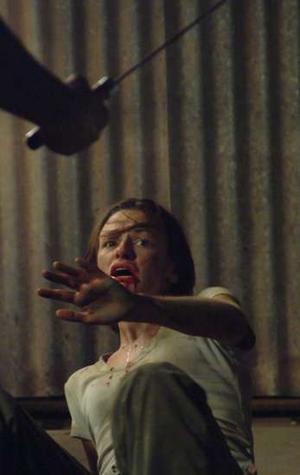
The common assumption of how a slasher film goes down: Young women menaced by a phallic weapon at the hands of a male aggressor.

The common assumption of how any slasher film goes down: Young women menaced by a phallic weapon at the hands of a male aggressor.

Games of Terror is about the formula far above and beyond gender ins and outs, but touches on it occasionally. In Men, Women & Chain Saws (hereafter MWC) Carol Clover pretty much tells porkies to illustrate her point, beginning with a meta-description of a slasher film that says a killer picks off ‘mostly female victims’, before using a bunch of films for reference where male victims outnumber females. Duh.

Still, numbers aren’t everything. The main point made in MWC is that terror is ‘gendered feminine’ and that can’t really be denied. Think back to almost every piece of slasher movie artwork commissioned, be it a quad poster, VHS cover, or DVD redesign, the recurrent theme is of a babe in peril, sometimes only partially dressed, often screaming as a shadow/blade/pair of straddled legs threaten her.
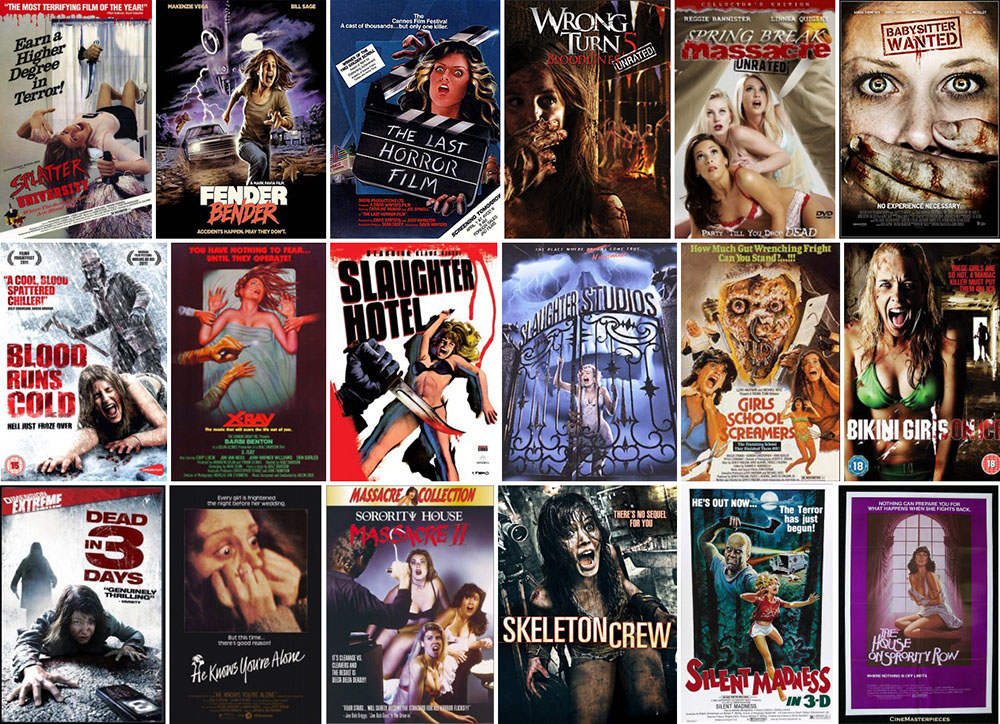
girls-in-peril-covers

Various girls-in-peril artwork, often featuring a phallic penetrative blade at the hands of a male aggressor.

This is evidenced in the mention of slasher films in other entertainment: In an episode of Will & Grace, a male character proclaims he feels “like a sorority girl in a bad slasher film”; in Sister Sister, girls at a slumber party watch a movie and narrate: “Freddy’s going after the girl.” A character in Dawson’s Creek refers to slasher films as being nothing but “masked men slashing up girls.” The popular myth of the genre appears to be that the slasher film is almost entirely about the torture of teenage girls.

The films lean heavily on the prolonged torment of their female characters – from the ‘quick scream and chop’ murders, the long chases down dark halls or alleys, to the final girl’s initial reluctance to fight back. To pin it down – how often do we see male characters tormented in the same way?

A large majority of slasher films are about a killer chasing girls, who happens to kill boys who get in the way: Sorority House Massacre, for example, is an exercise in babes in peril: The killer wants only to kill girls who resemble (to him) his sisters, the male victims (who incidentally outnumber females 5 to 3) just happen to cross his path and must be eliminated.
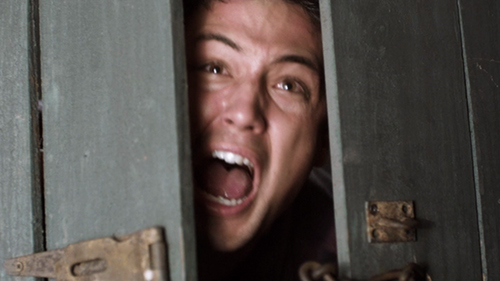
mask maker

Boys scream and flee too

My argument would be that the expanded terror afforded to teenage girls in slasher films is in part ‘made equal’ by the greater number of male victims over all. 697 films in, male fatalities outnumber the fairer sex 61% against 39% with only 20.5% of films featuring more murdered women than men.

I raised this on a blog to which the author responded with a surly comment that the fact men ‘also’ die doesn’t detract from the misogyny at work and that slasher films serve to play to male fantasies of women being cut up. If so, why have male victims at all, let alone more male victims? I don’t for a second believe that Terror Train‘s singular off-screen female homicide out of TEN murders plays into any such nonsense, same goes for Happy Birthday to Me, and the two-vs-six body count in Hell Night. Do dead men matter less?

The point was compacted by the fact that in her essay, the writer didn’t namecheck or reference a single post-Halloween slasher film. Not one. Dressed to Kill, some 70s proto-slashers, and giallo films do not your point make. If I’d handed in an academic essay on film without citations, no matter how well written, I’d have failed. It’s baseless, anecdotal at best.
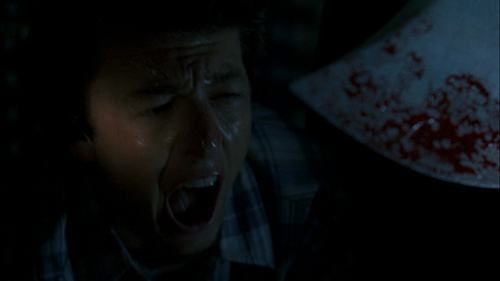
7eventy 5ive

That said, critics would often state that the way in which women – particularly attractive teenage girls – are killed tips the balance. Despite box office receipts for Halloween and Friday the 13th showing 55% of under-17s were girls, most teen-horror is still written, produced, and directed by straight men, and thus the inextricable link between slasher films and T&A has never died out – look no further than IMDb boards for hordes of complaints when a slasher film doesn’t feature any nudity.

Clover made a point of stating that boys die because they make mistakes, whereas girls are murdered because they are girls. While this might resonate in low-end exploitation films where the killer targets only females and a male happens to get in his way, early plot-driven slasher films heavily leant on mystery angles where the killer targeted a specific group of young people, always mixed gender. The boys in Terror Train die because of their prank against the killer; boys in Friday the 13th are doomed as much as their girlfriends because the killer is hellbent on obliterating them all; same goes for Graduation Day, Hell Night, My Bloody Valentine… Errors in what dark room they should or shouldn’t enter aside, nobody in these films is killed ‘because of their gender’.
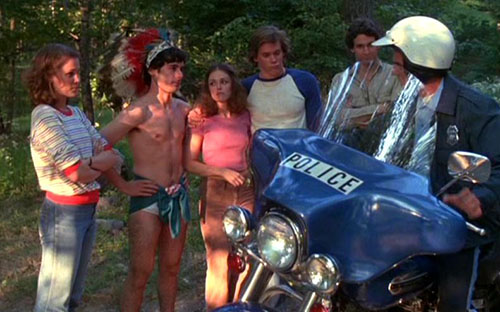
The boys and girls of Camp Crystal Lake: Equally doomed

The boys and girls of Camp Crystal Lake: Equal opportunity doom

The sequences leading up to the murder of a female character is usually more drawn out than that of her male friends. One might say that the quick from-behind hijacking of boys in slasher films is to prevent a physical retaliation less likely to occur when a girl is stalked. This could also feed into the lack of instances across the board of a male in terror: ‘Weak’ men scream (see Trent in the Friday reboot) and run away; ‘real’ men stay and fight (see Julius in Jason Takes Manhattan) even if they almost always fail. The myth that is upheld is that when it comes to fight or flight, men will choose the former, women the latter.

Taking the Friday films as an example, in the oft-seen sequence where a couple’s sex is interrupted, most of the time the boy will leave the girl to get ice/beer/investigate a noise, and be killed first, usually quickly. This leaves the girl alone in the house/cabin with the killer, the scene slows down, the photography fragments, framing her from a variety of angles to confuse the viewer into wondering where he will pounce from, while she takes a shower, calls out for the boy, or flees having stumbled across his body.

In the 2009 remake of My Bloody Valentine, this was cranked up in a scene where the male half of a recent tryst dresses and leaves, while the woman follows him, completely naked, and is then pursued by the killer after the man is suddenly offed with a pickaxe. His death is swift, over in a second, while she is subjected to being accosted, stark naked, screaming, hiding, and hopelessly trying to defend herself.

It’s worth noting though that fellow 2009 slasher, Tormented largely reversed this scenario, with a buff guy in partially-on boxer shorts, runs across a school campus from his killer.

my bloody valentine betsy rue naked

Naked, tormented victim in My Bloody Valentine (2009)

Then there are the films where female characters are punished for ‘sins’ that pale in comparison to those of their male contemporaries, who are spared: Valentine begins with three girls refusing to dance with a dorky boy, while a fourth accuses him of attacking her so that a group of boys pour punch over him, strip him to his underwear and kick the crap out of him. Years later, the girls are stalked and slashed, the boys seemingly forgotten. The same thing applies in My Super Psycho Sweet 16, where several jocks beat up the dorky friend of the heroine, but only the ringleader is killed, whereas the female friends of the bitchy girl are beyond redemption, even when one of them expresses remorse for the way they’ve treated the final girl, and all are summarily murdered.

In Girls Nite Out cheerleaders on a scavenger hunt are slashed by a killer who roars “Slut! Bitch! Whore!” while a roster of extremely annoying frat boys, the nominal hero of whom cheats on his girlfriend, escape the blades. That the killer turns out to be female may be a half-hearted effort to side-step the misogyny in play as a woman judging the promiscuity of other women rather than a man. The Prowler is another early film where the killer targets girls, after his ego is bruised by being dumped 35 years earlier. The three male victims (out of seven) killed are either attacked from behind without even seeing the killer or shot out of the blue. The Burning sees a group of boys roast a caretaker almost to death, yet when he returns for revenge several years later, his victims are primarily female.

Few films have tried to flip this trend: The Slumber Party Massacre may have been meddled with during production, but aspects of the initial missive come through – the boys die quickly, shrieking and thrashing as they’re stabbed or drilled, while the girls pool their resources and strike back with ferocity, figuratively castrating the killer by lopping the end of his phallic drill-bit, playing up to the notion that the male killers are impotent men incapable of sexually pleasing a partner, so opting to stab her over and over with a phallic weapon in a grotesque perversion of the sexual act.

The ending of The Slumber Party Massacre is an excellent celebration of oestrogenic fury as the trio of final girls retaliate, and still the film was eventually pushed out with a ‘traditional’ emphasis on the babes-in-peril angle:
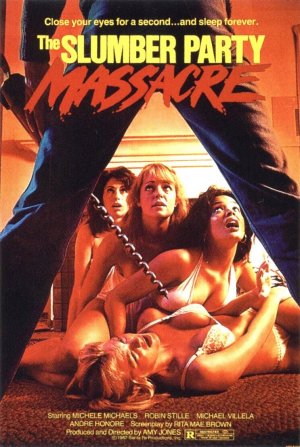
slumber party massacre cover 1982

Equating violence with sex doesn’t come much more obvious than that.

Later on in the cycle, the tropes began to be parodied. In Cut (2000) the tyrannical (female) director yells at the actor playing the killer for forgetting to cut open a victim’s blouse before slashing her throat; the slasher film being made in Brian De Palma’s Blow Out is also run by a producer who wants girls for “tits and a scream”.

The Scream movies have often been cited for portrayals of strong women. However, it’s worth noting that in those movies, the stalking element is exclusively geared towards girls – the Halliwell Film Guide even summarised the plot of the original as “a killer is murdering girls” in spite of the fact that more males die. In each Scream however, the opening scene shows a young woman (or women) being tormented by the killer. Her male companion is usually killed off quickly. The third film flipped it and the male character’s death was more protracted, and the fourth opted for a clever joke of an opening with two fake-outs before the real double-murder, ultimately amassing five deaths of young women. This is a series that may push Sidney Prescott and Gale Weathers to pound on their male aggressors, but is pivoted by men who are always attacked either from behind or with no time to act, and girls who run and scream before they’re killed.
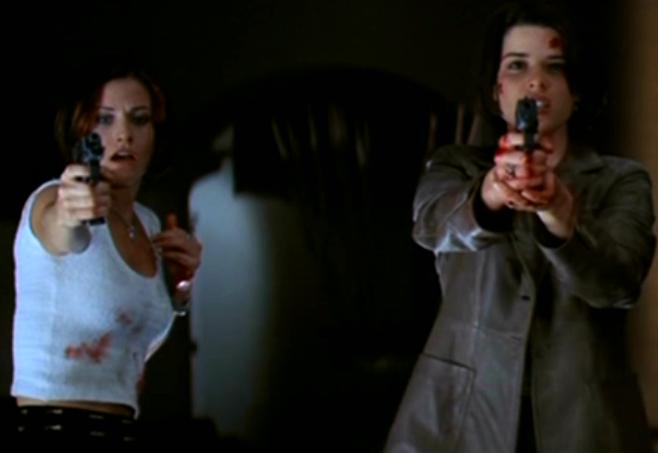
Double final girl power in Scream 2, offsetting the run and hide nature of other female victims in the series

Double final girl power in Scream 2, offsetting the prolonged torment of other female victims in the series

More recently, in the 2015 indie pic Bastard, all relevant roles are taken by women: The killer, final girl, and her would-be saviour. This is a film where the only on-screen murders are of men.

Conclusively, there’s no way to call it. There are exceptions to every rule the slasher universe has ever thrown out: Protracted male chase scenes occur in Mask Maker and I’ll Always Know What You Did Last Summer, but they lack the fear on behalf of the viewer for the fate of the victim. Do we care more about the girls than the boys? Read a few IMDb boards and you’d think anything but.

The back and forth could go on and on, but given that the slasher realm offers meaty leading roles for women, I’d say that trumps most accusations of misogyny. It’s got to be far more empowering to watch Jamie Lee Curtis, Amy Steel, Heather Langenkamp, or Neve Campbell fight off a killer with ferocious gusto than see them playing the wife or girlfriend of a guy who has all the adventures in any other genre.

Personally, a slasher film without screaming girls running about is usually a bad one, but I tend to get tetchy when the motif is repeated more than once per film, or when asshole guys are given a free pass while their much nicer girlfriends are brutally slain (see Honeymoon Horror, Berserker, even the recent Most Likely to Die). The best genre examples levelled it out: Kill some boys, kill some girls, but always leave one girl to save the day.

So are they misogynistic? I’d say largely – intentionally – no, but some certainly have their moments.

Mortu- no wait… Funeral Home!

funeral home 1980

FUNERAL HOME

2 Stars  1980/93m

A.k.a. Cries in the Night

“Some things never rest in peace.”

Director: William Fruet / Writer: Ida Nelson / Cast: Kay Hawtry, Lesleh Donaldson, Barry Morse, Dean Garbett, Stephen Miller, Alfred Humphries, Peggy Mahon, Harvey Atkin, Jack Van Evera.

Body Count: 4


Excuse me if I confuse this with Mortuary…

Psycho rip-offs don’t come much more blatant than this tame Canadian stalker, an early film for William Fruet, who later directed several episodes of the Friday the 13th TV series, as well as underrated campus horror Killer Party.

Goodie-goodie teen Heather (Donaldson) goes to visit Grandma for the summer and help her out at her guesthouse, previously a funeral parlour occupied by the grandmother and her late husband. Heather thinks she can hear voices coming from the cellar, where she has been forbidden to ever go.

When a businessman and his mistress check in but refuse to leave when asked, their car (with them inside) is shunted into a local quarry by a mystery truck. Then Mr Davis is murdered after confessing he’s in the area looking for his missing wife, who was reportedly having an affair with the late undertaker, who also disappeared some time earlier. Heather becomes more and more paranoid that there is somebody living under the house and eventually, spurned on by her love interest, snoops where she shouldn’t…

Material lifted from Hitchcock’s masterpiece is prevalent: the location, the cellar, even the killer’s twisted logic when eventually revealed and it’s clear that it was made primarily in response to Halloween rather than Friday the 13th. Unfortunately, slack pacing for the first two thirds makes it a bit of a chore to sit through, although it’s nice to see a few faces from other genre films dotted amongst the minimal cast.

Blurbs-of-interest: Lesleh Donaldson was also in Curtains and Happy Birthday to Me; Jack van Evera and Alf Humphries were both in My Bloody Valentine; Harvey Atkin was in Visiting Hours; Stephen Miller was in Matinee and The Stepfather.

Welcome to Australia

wolf creek tv series 2016

WOLF CREEK (TV SERIES)

4 Stars  2016/288m

Directors: Tony Tilse (5 episodes), Greg McLean (1 episode) / Writers: Felicity Packard & Peter Gawker / Cast: John Jarratt, Lucy Fry, Dustin Clare, Jessica Tovey, Fletcher Humphrys, Deborah Mailman, Jake Ryan, Richard Cawthorne, Eddie Baroo, Matt Levett.

Body Count: 24


TV was the new movies in the 2000s, with bigger budgets, drawn out arcs sucking in squillions of viewers that your favourite movie could never. Legal dramas, police procedurals, mafia families, drug dealers, vampire hunters, and trundling along at the rear, like the runt of the horror litter it’s often seen as, slasher tales.

First came Harper’s Island, then Scream – The TV Series, and the risible Scream Queens, the subtley titled Slasher, and now from down under, Wolf Creek.

On the back of the pair of brutal homegrown Aussie flicks, which chronicled the never ending killing spree of the outback’s answer to Freddy Krueger, Mick Taylor, as he raped, pillaged, and knifed nubile tourists who ventured beyond the city limits. Based on the real crimes of backpacker murderer Ivan Milat, Wolf Creek‘s gritty and repellent presentation of vulnerable outsiders thrown into a truly nightmarish situation resulted in a film even I found too intense to return to.

wolf creek tv series mick taylor john jarratt 2016

At the end of Wolf Creek 2 in 2013, Mick once again evaded capture and death and lived to hunt another day. The TV series starts with Taylor doing what he does so well: Killing. Selecting the American Thorogood family, who unwisely park their huge RV at a billabong where pre-teen son Ross is almost chomped by a saltwater crocodile, Mick shoots the reptile and is invited to supper. While Mom and Dad chatter, 19-year-old daughter Eve finds their guest a bit much and goes to lie down with some music.

Mick makes quick work of the parents and little brother, and goes after Eve, who, as a committed athlete, bolts for her life, but is shot down in the distance. Unable to find her body, raspy-voiced Mick chalks it up to croc bait and burns down the RV and disposes of all evidence of murder. Eve is rescued by some birdwatchers the next day.

wolf creek tv series 2016 lucy fry

Detective Sullivan Hill is assigned to the case and carries an ever-growing folder of possible crimes committed by the anonymous psycho in the outback. His attempts to put Eve on a plane back to the US are foiled when she runs away, steals the folder, buys a van and takes off in the direction of the crime.

Over the next few episodes, Eve follows Mick’s trail of murder around the desolate outback of the Northern Territory and Western Australia, while Hill follows her. She befriends a stray dog (named ‘Dog’) and finds herself in a series of bizarre and deadly situations, from being arrested for possession of weed (which was left in the van she bought by its previous owner), escaping prison, stealing cash and a gun from a biker gang, facing off a would-be rapist, solving a murder, and researching Mick’s previous murders. Each episode has a small arc within the greater story, as Eve goes from teary victim to woman warrior.

wolf creek tv series 2016

Of course, this journey is anything but smooth: Eve steps in bear-traps, is attacked by horny blokes at least twice, bitten by a venomous snake, and almost murdered by a crazy subterranean dweller. She also finds time to go all Daniel LaRusso with an outback saviour, who teacher her the aboriginal way of throwing a spear – something that’ll come in handy later, of course.

Original creator Greg McLean declared that Wolf Creek in this incarnation is less about Mick than it is Eve, and, wisely, the killer is limited in his appearances, cropping up here and there, stalking and killing a few poor folks as his and Eve’s paths grow ever closer to crossing: After a couple of episodes, he is aware someone has survived and is out to find him, he murders her would-be rapist, they ask about one another at the same roadhouse, with Hill just a heartbeat behind.

wolf creek tv series 2016

Elsewhere, the hoodwinked bikers are chasing her, allowing for an amazingly funny interchange when one of them catches up with her, proclaiming he needs a woman to give him kids instead of killing her. The Wolf Creek movies featured generous slabs of dark humour from Mick, but additional skits from background players here do a lot to endear the viewer to the production.

As things wrap up in the final two episodes (of a perfectly pitched six), Eve tracks Taylor to a drinking hole, which also – a little too conveniently – is frequented by a mad local known as Jesus, who is revealed to be Ben, only survivor of the first movie. Weird that they never ran into one another? She is finally able to put a lid on the biker situation, and follows clues left by Mick to lead her to the Wolf Creek Crater and then his lair.

wolf creek tv series 2016 john jarratt lucy fry

The only arguable flaw at this juncture is the appearance of Mick’s backstory in black and white flashbacks to his childhood, which serve as the starting point to his murderous career. It denigrates his repulsive character to some degree, almost drawing sympathy from the audience, and aligning him even closer to Freddy Krueger than before, as he appears behind Eve with a few witty remarks at his disposal, further cementing the similarity.

So it comes down to survivor versus legendary maniac in a final showdown that seems over a little too soon, and lacks an amount of finality that points towards a second series in the future – but how can Mick survive what Eve finally does to him?

wolf creek tv series 2016 dustin clare

Much IMDb crying occurred over the series being too slow, Eve not being ‘right’ to take on Mick, and him not being in it enough. However, keeping the tempo of the films over almost five hours is never likely to work and would not be sustainable, and largely physically impossible for the characters. It was 100% the right decision to keep Taylor in the shadows as much as possible. Eve is also the perfect opponent – an outsider in every possible way, a recovering opiate addict, and an unlikely survivor.

Easily the best slasher series on virtually every level, from the lush production values, use of the agoraphobic Australian landscape, where, despite so much space, there’s still nowhere you can run. Jarratt, Fry, and the impossibly handsome Clare all put in excellent performances, and every bit-parter makes an impression, Dog included. Given this was almost the 700th slasher ‘thing’ I’ve seen, for me to find it so fresh and binge-watch over two days underscores just how much I loved Wolf Creek. So great.

wolf creek tv series 2016 lucy fry

P.S., that full frontal nudity? It’s a guy.

Blurbs-of-interest: Jarratt also featured in Next of Kin and Needle.

Dildo Defence

bastard 2015 dvd

BASTARD

3 Stars  2015/18/82m

“The lucky ones die first.”

Director: Powell Robinson, Patrick R. Young / Writer: Patrick R. Young / Cast: Rebekah Kennedy, Ellis Greer, Dan Creed, Tonya Kay, Will Tranfo, Burt Culver.

Body Count: 9

Laughter Lines: “Logic dictates you shut your whore-mongering mouth!”


This strange indie production has a whole lot more going on than your average teens-in-the-woods slasher film, distinguishing itself with complex characters, oddball situations, and lots of grue. Imagine Mountaintop Motel Massacre (with better production values) by way of some cult 70s grindhouse killer-couple flick… if you can?

Unavoidable spoilers must follow to paint this picture with any degree of accuracy.

So, West and Hannah are newlyweds in their own band who have no qualms about killing people to furnish themselves with better cars, free things, and say ‘cunt’ a lot.

Jake and Betty are teenage runaways from an apparently abusive parental situation, trying to make it somewhere on their own. He’s all optimistic, she wants to go home.

bastard 2015

Michael is a suicidal transvestite policeman with a drink problem and confronting in-car tapes that tell him to stop being a pussy.

Fresh from killing some schmuck and appropriating his convertible, West and Hannah pick up Jake and Betty and the four of them end up in a small town with just the one B&B – owned by the happy and welcoming Rachel. Elsewhere, a horny couple engaged in some serious S&M play have been murdered by the lake near the hotel.

Hannah is in a very bad mood which only worsens when West doesn’t return from burying the body of their car’s former owner. He’s bumped into a baby-masked loon who swishes a lethal cleaver.

bastard 2015

In the morning, Rachel leads her guests (and Michael) on a forest hike. Hannah goes off to find West but instead bumps into the killer and fights back with a giant dildo she finds in the sand (belonging to our dead couple from the previous day). In a truly never-been-done-before moment of genius, the dildo flies in slow motion to strike the killer across the chops while Ave Maria plays, but Hannah receives a hook in the thigh for her trouble.

The alarm is soon raised, more bodies quickly drop before it’s revealed Rachel is the killer (guessed it right – yeah!!) Only Hannah and Betty remain, and it’s revealed that not only is the latter is pregnant with Jake’s baby, but he’s also her brother! Bastard loves to toss these curveballs.

Now, the final act sees Betty tied to a bed and forced to watch a video montage of Rachel’s miserable life in a pseudo-explanation of her crimes. She wants the baby for herself is the simple answer – alas I watched very late at night and had to have the volume down so I missed a few whispy parts of dialogue. Still, Hannah comes bursting to the rescue, affording Betty the chance to escape. But will she?

bastard 2015

Bastard has a strong feminist vibe to it: The three crucial parts are all played by women – killer, final girl, and (would-be) saviour. Also, we only see male’s killed on screen, pretty much stomping most of the “this is sexist!” critique the genre puts up with to dust.

I’ve seen so many slasher films now that it’s nice to see one that doesn’t quite follow the rules and goes off on little mad tangents rather than sticking rigidly to Teen have sex > Teens die like many of its contemporaries.

1 … 48 49 50 51 52 … 179


