Slashifying the Classics Part II: Poe

masqueTHE MASQUE OF THE RED DEATH

3 Stars  1989/18/89m

“Death is the life and soul of the party.”

Director: Alan Birkinshaw / Writers: Edgar Allan Poe & Michael J. Murray / Cast: Herbert Lom, Michelle McBride, Frank Stallone, Brenda Vaccaro, Christina Lunde, Simon Poland, Christobel d’Ortez, Foziah Davidson, Lindsay Reardon, Godfrey Charles.

Body Count: 10


Shot in South Africa, this is one of two adaptations of Poe’s story shot in 1989, morphed into a masquerade ball slasher pic by screenwriter Michael Murray. In this version, a red caped and masked fiend sends a group of attendees to the slab.

Pretty McBride is a journalist who snuck in to try and get some snaps and a story from loudmouth soap star Vaccaro at the final party of the mysterious Ludwig (Lom) in his creepy Bavarian castle. Those up for the chop include actors, designers, and doctors with whom he is somewhat intimately associated. They’re offed by sword, axe, and even razor sharp pendulum.

Frank Stallone gets top billing for his rather marginal part, but McBride carries the weight of the film as the sympathetic – and ever so slightly simpleminded – heroine. Lom is good in his is he/isn’t he role of host.

Most observers have dismissed this as a travesty to Poe’s work, but if an interesting take on the tale, marred by the revelation of the rather comedic killer, which unearths a couple more twists before a rather satisfying end to their evildoings. Silly laughs do divert proceedings time and again, although there’s one honest gag at the end of the credits which is worth hanging on for.

Blurb-of-interest: Birkinshaw directed British oddity Killer’s Moon in 1978. Producer Harry Alan Towers was also behind the Poe adaptation Buried Alive in the same year.

Slashifying the Classics

phantom of the opera 1989 robert englund

THE PHANTOM OF THE OPERA

3.5 Stars  1989/18/89m

“Only love and music are forever.”

Director: Dwight H. Little / Writers: Gaston Leroux & Duke Sandefur / Cast: Robert Englund, Jill Schoelen, Alex Hyde-White, Bill Nighy, Stephanie Lawrence, Terence Harvey, Nathan Lewis, Peter Clapham, Molly Shannon.

Body Count: 10

Laughter Lines: “Everybody dies. I only choose the time and place for a few.”


Robert Englund likely sailed through any audition process to play another homicidal burn victim, in the 83rd take on the Gaston Leroux novel – although any associations with the Andrew Lloyd Webber musical are mercifully absent.

One-time scream queen Jill Schoelen is Christine, a young operative vocalist who spins back to her previous life in nineteenth century London after a bang on the head at an audition. When the Phantom scares the wits out of the Faust Diva, Christine takes over, while the Phantom knocks off anyone who gets in the way of her success.

Largely shot in Budapest, the slasher elements are brought to the fore, with victims decapitated, gutted, and impaled in several gruesome scenes, that were significantly cut down to avoid an X-rating. The producer almost bankrupted himself pouring money into the film, which subsequently tanked.

phantom of the opera 1989 jill schoelen robert englund

Despite this, Englund looks to relish flexing his acting muscle without having a razor glove attached to him, and Elemer Ragalyi’s lush photography fashions a fine looking film. The cast, too, is peppered with recognisable faces and before-they-were-famous names. Perhaps the concept of and upgraded slasher film or downgraded classic, depending how you look at it, is what killed it in the end, but at least it makes for an arty and credible diversion from the usual teens-at-a-party slasher fare. A sequel planned to take place in New York (The Phantom Takes Manhattan?) starring Englund was eventually canned.

Blurbs-of-interest: Aside from playing Freddy Krueger in eight movies, Englund can also be found in Behind the Mask: The Rise of Leslie Vernon, Hatchet, Heartstopper, Urban Legend, and Natty Knocks; Schoelen was in The Stepfather, Cutting Class, and Popcorn; Terence Harvey was later in similar 19th century slasher variant From Hell; Dwight H. Little directed Halloween 4 the previous year.

Separate Chapters

the dark half 1993

THE DARK HALF

2.5 Stars  1993/18/116m

“Serious writer or serial killer. Thad Beaumont is in two minds.”

Director/Writer: George A. Romero / Writer: Stephen King / Cast: Timothy Hutton, Amy Madigan, Michael Rooker, Julie Harris, Robert Joy, Chelsea Field, Royal Dano, Rutanya Alda, Beth Grant, Kent Broadhurst, Tom Mardirosian, Glenn Colerider.

Body Count: 10


Given that Stephen King wrote the book, Night of the Living Dead creator George A. Romero directed it, and it’s almost two hours long, this is a strangely uninvolving venture, shot in 1991 and released two years later due to financial problems with the studio.

King adaptations are difficult creatures to grasp – for every Carrie or Misery there’s a Sleepwalkers or Maximum Overdrive (which a coked-out King directed himself) – so it’s kind of neither here nor there that The Dark Half vanishes between the extremes: Not a bad film, but not a particularly interesting one either.

As a kid, Thad Beaumont suffers from strange episodes where he hears sparrows. Doctors later find evidence of a twin absorbed in utero – there’s an icky scene where a blind eye opens up inside his exposed brain. Once removed, Thad grows up to be a struggling author – been there, bud – on the verge of a breakthrough and, in the meantime, teaching creative writing students about allowing that darker self through in their work.

dark half timothy hutton

Thad is soon blackmailed by a shady guy who has found out that he’s been writing low end, high selling trash novels under the nom de plume George Stark. His agents advise him to own it and a publicity stunt is staged where he and loyal wife, Liz, mock-bury Stark in a local cemetery – and that’s where the horror begins.

First to go is the publicity stunt photographer, who is beaten to death with his own prosthetic leg, then the blackmailer is found dead… Local Sheriff Alan Pangborn informs Thad that his fingerprints are found at the scenes, but how can he be in two places at once? Schizo-Haute Tension shenanigans going down? Or is George Stark real somehow? And what’s with the sparrows?

I’m not sure as to Stephen King’s opinions on slasher movies, but I wouldn’t think they were particularly favourable, but the elements at work in The Dark Half do verge into that territory, with ‘George’ continuing to off people important to Thad, agents, interviewers, cops assigned to protective duty, and the doctor who backfills the story about the twin-that-never-was… The usual luckless schmucks really. There is a scene later with some psychobabble that attempts to make sense of it, providing Thad with his possible out, and giving Stark time to abduct Liz and the kids.

dark half 1993

The sparrows eventually come to help out in a Birds-esque scene, that’s pretty inventive, but I just never felt particularly attached to anybody’s plight. Hutton, apparently difficult to work with on set, just doesn’t seem to care a great deal about the fates of his friends and colleagues, and even his infant twins seem like they might just be expendable. On the plus side, I was glad that things didn’t turn out to just be all in his head, and the higher-end production gloss helps, but I never need to see it again.

Blurbs-of-interest: Timothy Hutton was later in #Horror; Michael Rooker was in Skeleton Man; Rutanya Alda was also in Girls Nite Out and You Better Watch Out; Beth Grant was the mean teacher in Child’s Play 2; Julie Harris was in Home for the Holidays.

The Art of the Kill

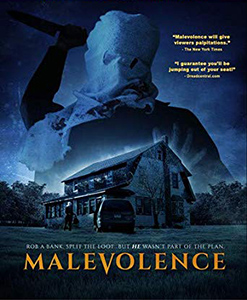
malevolence 2004MALEVOLENCE

3.5 Stars  2004/15/86m

“Ma-lev-o-lence; evil, disposed to injure others.”

Director/Writer: Stevan Mena / Cast: Samantha Dark, Brandon Johnson, Heather Magee, Courtney Bertolone, Richard Glover, John Richard Ingram, Keith Chambers, Kevin McKelvy.

Body Count: 5


A much-praised micro-budget ($70k) homage to slashers of olde, the work of cinematographer Tsuyoshi Kimoto is the star here. His ability to frame and compose angles to wring as much tension as possible out of what little there is visible on screen in the dark compensates for many of the film’s shortcomings.

A kid is abducted in 1989. Ten years later (never nine, never eleven) a quartet of bank robbers make a break for freedom and end up separated. One succumbs to a gunshot wound, leaving his sister and her boyfriend to bury him, making them late for the rendezvous with the fourth member of the group, who has had to take a woman and daughter hostage in his bid to commandeer an escape vehicle.

malevolence 2004

Unfortunately for them all, the chosen point of their regrouping is also dangerously close to the shut-down Sutter Farm, where it seems a serial killer hangs out. When the young daughter escapes and ends up there looking for help, robber dude meets a nasty end, leaving his remaining compatriots to discover the captive mother and only $40k of their almost half-a-mill haul.

The killer appropriates a sheet mask from Dead Robber #2, one not dissimilar to Jason’s sack-mask in Friday 2, emphasized by the check shirt and dungaree ensemble he also rocks. Then, he hangs around in the back of the frame, slowly venturing closer while the two remaining felons argue over what to do next, and mom whines for the return of her daughter.

malevolence 2004

Halloween is also aped to shit, from the bluish hue the film carries after dark, to the distinctive angles that make the old farmhouse look claustrophobic. Off-centre shots pose on-going questions about where the loon is hiding, creating a decent amount of nail-biting. When the blows come, they’re strangely tame, with only a few on-screen murders even occurring. Anyone who’s seen late-90s rarity Freak will notice an overlap in the subdued approach to displaying anything graphic.

So that’s the good. In spite of the acclaim Mena received for delivering a good lookin’ indie flick for the cost of a new car, he seems to have trouble goading convincing performances out of the cast, who present a very stagey approach, as if they’re deliberately not looking over their shoulder when anyone else would sense that other presence in the room. This leaves the film lacking a strong connection with any of the characters because they’re just not very convincing, a trend which I noticed again in Malevolence 3 (the middle film, Bereavement, had a couple of names but I can’t remember much of it now). The mother-child combo should evoke a much deeper level of concern than it does.

malevolence 2004

The killer’s identity also offers little to gasp about. An overlong epilogue where the FBI swoop in to stitch up some Q&A feels out of place and wouldn’t be resolved until the third movie came along 14 years later.

A beautiful experiment on a visual level, but the script can’t keep that flame out of the breeze, sadly.

Blurbs-of-interest: Brandon Johnson was in similarly minimalist slasher Little Erin Merryweather; Kevin McKelvy reprised his role in the third film.

When she was bad

alice sweet alice 1976

ALICE, SWEET ALICE

4 Stars  1976/18/103m

“If you survive this night… Nothing will scare you again.”

A.k.a. Communion; Holy Terror

Director/Writer: Alfred Sole / Writer: Rosemary Ritvo / Cast: Linda Miller, Mildred Clinton, Paula Sheppard, Niles McMaster, Jane Lowry, Rudolph Willrich, Michael Hardstark, Alphonso DeNoble, Brooke Shields, Gary Allen.

Body Count: 4

Laughter Lines: “My mother thought you could use some cake, fatty.”


You know that meme of the little girl almost smiling in front of a burning house? That’ll come to mind when the credits roll here.

I grew up in a very religious environment – church every Sunday, although instead of a church, it was some outhouse in a guy’s garden known at The Tabernacle where sermons or whatever lasted 2-3 hours every week. Sounds more like a cult now that I write it down.

Nothing turns a kid away from religion (and into the liberating arms of horror movies) quicker than having it forced upon you, so it’s no surprise now I don’t categorise myself as having any belief. Agnostic, I suppose. I believe in nature, rather than a sentient higher power that cares deeply about our every thought or notion.

alice sweet alice 1976

Seems like maybe Alfred Sole had a similar thought process about Catholicism as evidenced by the quite anti-organised religion sentiments at work in Alice, Sweet Alice, a quirky, plot and character driven pre-Halloween production that draws some inspiration from the Italian giallo subset.

“Parents so often don’t know their children as well as they presume,” says a shrink of Catherine’s troublesome oldest, Alice (Sheppard, who was 19 playing 12), who is mean to her little sister Karen (Brooke Shields in her debut), and runs around their rooming house with a creepy plastic mask on, torments the obese, predatory landlord, and is known for explaining away the messes she gets into as accidents.

alice sweet alice 1976

This excuse might not fly when good little Karen is murdered before she can take her first communion by a figure in the uniform yellow rainmack all the parishioners of their church have and Alice’s creepy mask. Where was she at the time? Why is she such a little bitch? Hang on, is this 1961!??

Yes. It is. Took me a while to notice it, but the film is set in 1961, making it that über rare non-contemporary slasher movie. Catherine’s ex-husband returns to mourn his daughter and stick around until the cops can work out who is responsible. When his squawking, shrill sister-in-law is attacked ‘by Alice’, the girl is carted off to a children’s hospital for observation as she’s now the chief suspect.

alice sweet alice 1976

The film takes the unusual step of revealing who the killer is the next time they strike and it’s a genuine surprise, affording the remaining ~40 minutes to pivot between their deteriorating psychosis as they try to justify what they’ve done in the name of their beliefs, and the tail-end of the investigation, with a few more stabbings thrown in for good measure.

I underrated this film for some time and my recent re-watch showed that the attention to characters and (for its era) interesting photographic setups are where its appeal lies. It’s almost as if Catherine and her ex (with whom she is amicable – a nice change) are the only sane people in a world where pomp and ceremony are prioritised over psychological well-being. Alice is an undeniably strange little kid who evokes little sympathy for her plight given her sadistic behaviour, which provides the ultimate commentary on the motivation of the actual killer, who feels they have more right to forgiveness than a divorced mother who married after she got pregnant.

alice sweet alice 1976

It’d be nice if subsequent slasher movies had as much to say on deeper issues, rather than dance around the edges claiming to be nihilistic protests over censorship. This is clearly a standout American film, one that deserves a lot more recognition than it ever got.

Blurbs-of-interest: Alfred Sole later directed the slasher parody Pandemonium.


1 … 28 29 30 31 32 … 172